Highlights:
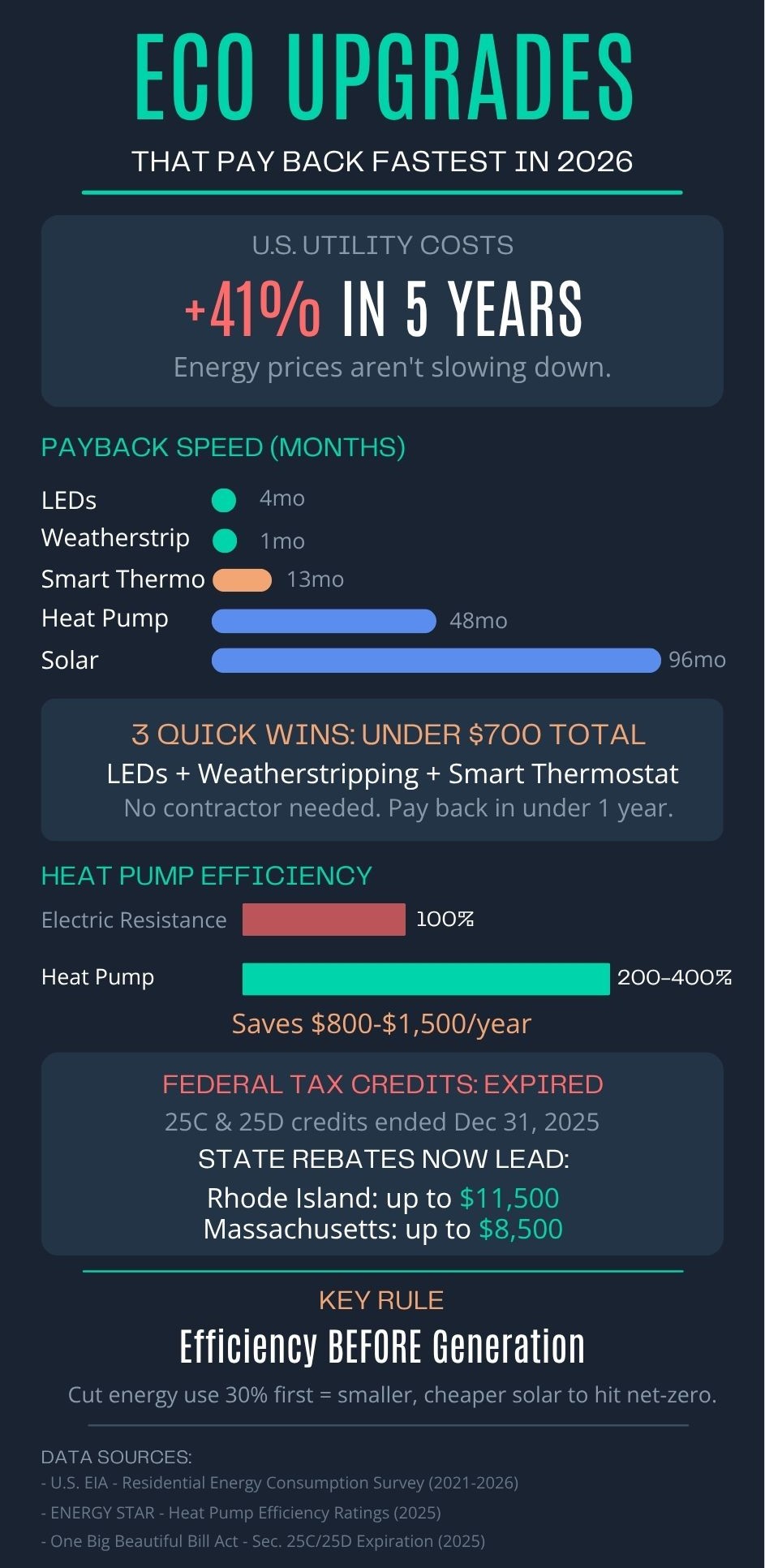
- Sequence your upgrades strategically. Don’t jump straight to solar or a heat pump — start with air sealing, LEDs, and a smart thermostat first. These cheap quick-wins (under $700 total) pay back in under a year and make every larger upgrade you install afterward more effective.
- The fastest payback wins are low-tech. LED lighting (2–6 month payback), weatherstripping (weeks), and smart thermostats (8–18 months) collectively cut energy bills by hundreds of dollars a year for a few hundred dollars upfront. No contractor required.
- Federal incentives are gone — know your state programs. The 25C and 25D tax credits expired December 31, 2025. Rhode Island offers up to $11,500 in heat pump rebates; Massachusetts up to $8,500. The state you live in now determines whether a heat pump or solar pencils out on a short timeline.
- Efficiency before generation. A home that uses 30% less energy needs a smaller — and cheaper — solar system to reach net-zero. Cutting waste first lowers your total investment and shortens the payback period on everything downstream.
- Heat pumps are the highest-impact upgrade for long-term savings, delivering 200–400% heating efficiency versus 100% for electric resistance systems. At $800–$1,500 in annual savings, they’re transformative — but they perform best (and pay back fastest) on a well-sealed, well-insulated home.
If you’ve been on the fence about greening your home, 2026 is a genuinely interesting moment to pay attention to the numbers. Energy prices aren’t easing up — U.S. household utility costs have climbed roughly 41% over the past five years — and the conversation around eco-friendly upgrades has shifted from “it’s the right thing to do” to “it’s the smart financial move.” The question isn’t really whether to upgrade anymore. It’s where to start, and more importantly, which upgrades pay you back the fastest.
That’s what this article is about. Not a vague list of green ideas, but a data-driven breakdown of the eco-friendly upgrades that generate the quickest efficiency gains — ranked by payback period, real-world savings, and what the numbers actually look like in 2026.
Let’s get into it.
Why Speed of Return Matters More Than Ever Right Now
Before we jump into the upgrades, a quick word on framing. When people talk about green home investments, they tend to focus on long-term ROI — and rightly so, because a solar system that pays for itself over 8 years and then runs for another 17 is a genuinely good deal. But for most homeowners, the speed of return is equally important. It determines whether an upgrade fits your financial reality, whether you’ll actually recoup the money if you sell in a few years, and whether the project makes sense to prioritize now versus later.
The good news is that speed and sustainability often align. Several of the upgrades with the fastest payback periods are also the ones with the highest long-term value — which means you’re not choosing between quick wins and smart long-term plays. You’re often getting both.
One more important note for 2026 specifically: the federal tax incentive landscape has changed significantly. Both the Section 25C and 25D residential clean energy tax credits expired at the end of 2025 under the One Big Beautiful Bill Act, meaning the federal credits that once covered up to $2,000 or 30% of heat pump and solar installations are no longer available for residential homeowners. State-level programs — like Massachusetts’ Mass Save offering up to $8,500 or Rhode Island’s Clean Heat program offering up to $11,500 — are now your primary source of rebates and incentives. This makes it more important than ever to check your state program before making any purchasing decisions.
With that context set, here are the upgrades that move the efficiency needle fastest.
1. LED Lighting: The Fastest Payback of Any Green Upgrade
Let’s start with the unglamorous one, because it deserves more credit than it gets. If you haven’t fully converted your home to LED lighting yet, this is still the single fastest-payback eco-upgrade available in 2026 — and it’s not particularly close.
The efficiency advantage is stark. LEDs consume up to 90% less energy than traditional incandescent bulbs, and the average household that makes the full switch saves around $225 per year on electricity costs alone. A full house conversion — bulbs, fixtures, and all — typically costs somewhere between $100 and $400 depending on home size, which means payback periods of just a few months, not years.
What often gets overlooked is longevity. A quality LED bulb lasts around 25 years under normal use, compared to roughly 1,000 hours for a standard incandescent. You’re not just saving energy — you’re eliminating years of replacement costs and the associated hassle.
For anyone doing a step-by-step efficiency upgrade (which is the smartest approach — more on that in a moment), LEDs should be Step 1. They’re cheap, the payback is near-instant, and they reduce the electrical load on your home before you invest in anything larger.
2. Air Sealing and Weatherstripping: Stop Paying to Heat the Outdoors
This one is almost embarrassingly overlooked. Before you install a smart thermostat, before you upgrade your HVAC, before you add insulation — you need to stop your conditioned air from escaping.
The U.S. Department of Energy estimates that a typical home loses up to 30% of its heating and cooling energy through windows, doors, and gaps in the building envelope. Another analysis puts the average cost of that inefficiency at up to $400 per year — essentially, money that disappears into the walls. Air sealing with weatherstripping, caulk, and door sweeps is an extremely low-cost intervention that addresses this directly.
The materials cost anywhere from $30 to $200 for a thorough DIY job on an average home. When properly done, air sealing can reduce heating and cooling costs by 15–30%, which on a typical utility spend translates to several hundred dollars per year. The payback period is effectively measured in weeks.
Here’s the strategic angle: air sealing multiplies the effectiveness of every other upgrade you make. A heat pump or smart thermostat working in a well-sealed home performs dramatically better than the same system installed in a leaky one. Poor installation, weak insulation, or leaky ducts can slash an HVAC system’s efficiency by 15–40% — which means every dollar you spend sealing your home makes your future HVAC investment more effective.
3. Smart Thermostats: Small Device, Outsized Impact
Smart thermostats are one of the most data-validated eco-upgrades available. We have years of real-world usage data now, and the numbers hold up remarkably well across climates and home types.
EPA data shows that ENERGY STAR-certified smart thermostats save households an average of 8% on their heating and cooling bills. That might sound modest, but consider what you’re working with: heating and cooling account for 45–55% of total home energy expenditure, according to the EIA. For a typical U.S. home spending around $4,300 per year on combined utility costs, that’s roughly $1,935–$2,365 going to HVAC. An 8% reduction on that figure translates to $155–$237 in savings annually — and in high-cost states like those in New England, where electricity rates have surpassed 29 cents per kWh (roughly double the national average), that number climbs considerably higher.
More recent industry studies put the range at 10–15% on heating and cooling costs for modern AI-driven models, reflecting improvements in learning algorithms and geofencing capabilities that older devices didn’t have. A head-to-head comparison conducted across two Indiana utilities found that smart thermostats saved 12.5–16.1% on gas heating — notably higher than programmable thermostats, which saved around 5%, largely because most owners don’t use programmable features consistently.
The cost of a quality smart thermostat in 2026 runs $150–$250. At current energy rates and typical savings, most homeowners recoup the device cost within 12–18 months. With utility company rebates — many energy providers now offer $50–$100 in instant rebates for ENERGY STAR-certified models — that payback window can shrink to under a year.
4. Insulation Upgrades: The Unsexy Investment That Compounds Everything
Insulation is one of those upgrades that doesn’t photograph well or generate excitement at dinner parties, but the financial case for it is quietly excellent — especially in homes built before the 1980s, where insulation standards were significantly lower than today.
A properly insulated home reduces heating and cooling waste substantially. When combined with air sealing, insulation upgrades can slash energy costs by 15–30%, with some estimates running higher depending on the starting baseline. In homes moving from poor to adequate insulation levels, annual savings of $400–$800 are commonly reported.
The strategic logic is the same as with air sealing: insulation amplifies everything downstream. If you’re planning to install a heat pump, adding attic or wall insulation first means your heat pump will be operating in a far more thermally stable environment — which improves both its efficiency and its lifespan. An HVAC system that doesn’t have to fight drafts and thermal leakage runs fewer hours, cycles less aggressively, and lasts longer.
Attic insulation, in particular, tends to offer the best ROI within the insulation category. Heat rises, and an under-insulated attic can account for a disproportionate share of winter heat loss. Costs vary significantly by home size and current insulation status, but attic insulation jobs typically run $1,500–$3,500 and pay back within 3–7 years through energy savings — often qualifying for state utility rebate programs that bring that timeline down.
5. Heat Pumps: The Highest-Impact Upgrade for Long-Term Efficiency
If you’re willing to think in a 3–10 year horizon, heat pumps are arguably the single most impactful eco-upgrade a homeowner can make in 2026. The technology has matured significantly — modern cold-climate units operate effectively down to -15°F, which was unthinkable a decade ago — and the efficiency advantage over conventional systems is substantial.
Heat pumps deliver 200% to 400% efficiency, making them two to four times more efficient than standard electric resistance heating (which maxes out at 100%). In practice, this means a heat pump produces 3–4 units of heat for every unit of electricity it consumes. Homeowners replacing electric resistance heating with a heat pump can expect to cut heating costs by 40–60%, or roughly $800–$1,500 annually for a typical home. Replacing oil or propane heating produces similar savings in dollar terms, especially given current fuel prices.
The numbers on payback are wide-ranging because they depend heavily on what you’re replacing, your climate zone, and available state incentives. General benchmarks: replacing electric resistance heating pays back in 3–7 years; oil heating in 4–8 years; propane in 5–10 years. In states with strong rebate programs, that math shifts dramatically. Rhode Island’s Clean Heat program, at up to $11,500, brings the payback period down to around 2 years. Pennsylvania, with less generous rebates, sees payback periods of 8+ years for the same hardware.
It’s worth reiterating: the federal 25C and 25D tax credits that previously covered up to $2,000 or 30% of installation costs have expired as of January 1, 2026. State programs are now the decisive variable in whether a heat pump pencils out on a short timeline. Do your homework on your state’s offerings before signing any contracts.
For HVAC efficiency ratings: look for SEER2 ratings of 16–18 for cooling and HSPF2 ratings of 8.5+ for heating. In hot climates, SEER2 18+ can save $200–$400 annually on cooling alone versus minimum-efficiency models. In cold climates, prioritizing HSPF2 over SEER2 makes more financial sense, since heating typically represents a larger share of annual energy use.
6. Energy-Efficient Windows and Doors: Better Than Their Reputation

Windows and doors often get dismissed as expensive and slow to pay back — and in isolation, that assessment is partially fair. But the data is more nuanced than the conventional wisdom suggests, and certain specific upgrades in this category offer surprisingly strong returns.
First, the loss numbers. The Department of Energy puts heat loss through windows and doors at roughly 30% of a home’s total heating and cooling waste — the same figure, notably, as through air leakage. Upgrading from single-pane to double- or triple-pane windows with low-e coatings can reduce that loss dramatically. According to ENERGY STAR data, making this switch saves households around 13% on total energy bills. Storm windows can cut heat loss by up to 50% compared to single-pane units.
The ROI on the door side of this equation is actually quite compelling. A steel entry door replacement has been documented at 188% ROI — meaning the upgrade adds more to home value than it costs — according to data from the Journal of Light Construction. At an entry-level cost starting around $150 for a basic steel door, this is one of the faster-payback envelope upgrades available.
For full window replacements, the calculus is more involved. The average cost of a quality energy-efficient window runs $2,450 per unit, and most new windows last 10–50 years. The energy savings are real, but the pure energy-cost payback period on windows alone tends to run 10–20 years. Where windows pay back faster is in the combined calculation: lower energy costs plus meaningful home value appreciation, since homes with green certifications and energy-efficient features typically sell for 2–6% more than comparable conventional properties.
If full window replacement isn’t in the budget, weatherstripping and window film can capture a meaningful share of the efficiency gains at a fraction of the cost. These low-cost interventions often payback within 1–2 years.
7. ENERGY STAR Appliances: The Quiet Workhorse of Home Efficiency
This one often flies under the radar, but the cumulative impact of switching to ENERGY STAR-certified appliances across a home is significant. Certified appliances use roughly 40% less power than non-certified equivalents — a figure that applies across refrigerators, dishwashers, washing machines, and dryers. Some analyses put the reduction even higher for specific categories, with energy consumption cuts of up to 50% documented for certain certified models.
The payback math here depends entirely on what you’re replacing. If your existing appliances are functional, replacing them purely for efficiency doesn’t pencil out well — you’re incurring a replacement cost against savings that take years to accumulate. But when an appliance reaches end of life and you’re replacing it anyway, always choosing the ENERGY STAR option is a straightforward financial win. You’re paying a modest premium (often $50–$150) for a device that runs meaningfully cheaper for the next 10–15 years.
Smart appliances add another layer: pairing ENERGY STAR appliances with time-of-use utility plans (which have become increasingly common as utilities modernize their billing) lets you shift high-energy tasks — dishwasher runs, laundry — to off-peak hours when electricity rates are significantly lower. In markets with aggressive time-of-use pricing, this behavioral optimization can add $100–$300 to annual savings on top of the base efficiency gains.
8. Solar Panels: The Longest Payback, the Biggest Long-Term Win
Solar is the upgrade with the most name recognition, and it’s also the one with the most nuance around timing and payback. Let’s be clear-eyed about both sides.
The long-term financial case for solar remains strong. Over a 25-year system lifespan, solar installations have been documented to save homeowners between $37,000 and $148,000 in electricity costs — a wide range that reflects differences in local electricity rates, sun exposure, system size, and financing structure. Homes with solar installations also see documented property value increases averaging 4.1%, equivalent to roughly $9,274 for a median-value home according to Zillow analysis.
The payback period typically runs 6–10 years for most installations. In high-sun markets like California and the Southwest, or in high-electricity-cost states like Massachusetts and New York, that timeline compresses toward the lower end. In moderate climates with lower utility rates, it can run longer.
The changed federal incentive landscape is worth repeating here. The 30% Residential Clean Energy Credit (Section 25D) expired December 31, 2025. That credit previously had no cap on solar installations, making it one of the most valuable residential tax benefits available. Its expiration makes state-level incentives and net metering policies more important than ever in evaluating whether solar makes sense for your specific home.
One recommendation that consistently improves solar economics: pair solar installation with battery storage. Without storage, a meaningful portion of solar-generated electricity flows back to the grid — often at rates lower than what you pay to draw power back. With battery storage, you retain that energy for your own use during peak-rate evening hours, maximizing the financial and environmental return on your generation capacity.
How to Sequence These Upgrades for Maximum Impact
The order in which you make these upgrades matters significantly, and the data is pretty clear about what works best.
The most common mistake is jumping straight to a big-ticket upgrade — solar panels or a heat pump — without addressing the home’s basic energy efficiency first. An HVAC system operating in a poorly insulated, drafty home has to work much harder, runs less efficiently, and wears out faster. Every dollar spent sealing leaks and improving insulation before installing a heat pump makes that heat pump more effective.
Here’s the sequence that the data supports:
Phase 1 — Quick wins (weeks to a few months):
LEDs, weatherstripping and air sealing, smart thermostat. Total cost: $300–$700. Combined savings: $400–$800/year. Payback: under a year.
Phase 2 — Envelope improvements (months to a few years):
Attic and wall insulation, window weatherstripping or film (if not full replacement). These compound the Phase 1 gains and create the foundation for Phase 3. Cost: $1,500–$5,000. Payback: 3–7 years.
Phase 3 — Major systems (years):
Heat pump (when HVAC replacement is due or state rebates make it compelling), solar, battery storage. These are the upgrades that generate the biggest long-term savings, but they perform best on an already-efficient building envelope. Cost: $10,000–$40,000+. Payback: 3–10 years depending on system and incentives.
Final Thoughts: Efficiency First, Then Generation
The biggest conceptual shift in eco-upgrades right now is the move from a “generate more” mindset to an “use less first” mindset. Solar panels are exciting and get all the attention, but a home that uses 30% less energy before any panels go up needs a smaller system to achieve net-zero — which means lower upfront costs, faster payback, and the same environmental impact.
In 2026, with federal incentives diminished and energy costs still rising, the smartest approach is a layered one: seal it, insulate it, automate it, then generate from it. That sequence consistently produces the fastest payback, the best long-term savings, and the most resilient home when energy costs shift further.
The data on all of these upgrades is now mature enough that the decision isn’t really about uncertainty — it’s about knowing your starting point and picking the right sequence for your home. Get an energy audit if you haven’t already; most utility companies offer them for free or at a subsidized cost. Let the data tell you where your home is leaking money, and start there.